The Targeting of Palestinian Paramedics and Emergency Medical Services
Content Warning
This page documents the killing of children, civilians and medical personnel. It contains recordings of people in distress and graphic photographs and videos.
Viewer discretion is strongly advised.
An Israeli air strike hit in the vicinity of an ambulance whilst they were evacuating displaced injured civilians in Salah Aldin Street, east of Al-Zeytoun neighborhood, a few days ago.
Source: @eye.on.palestine IG https://www.instagram.com/reels/Cz8Iv5VqtAi/
PUBLIC EVIDENCE SUMMARY
IDF attacks on ambulances & paramedics in gaza and the westbank
Since October 2023, Palestinian paramedics, ambulances, emergency medical centers, and rescue missions have repeatedly come under attack. Medical workers have been killed and injured while responding to emergencies. Ambulances have been bombed, fired upon, obstructed, damaged, and prevented from reaching wounded civilians. Emergency centers have been besieged, communications systems disabled, and medical workers detained during humanitarian operations.
The Sarkha Project collected, preserved, verified, translated, and organized hundreds of open-source records documenting these attacks. Together, the evidence reveals a sustained pattern of violence and obstruction that has severely impaired Palestinian emergency medical response in Gaza and the occupied West Bank.
Evidence package at a glance
Evidence Package Completed 6 August 2024
The evidence package contains:
409 source records
Evidence organized across 11 investigative categories
Original posts, videos, photographs, statements, reports, translations, and preserved copies
Documentation extending through June 2024
The report also identifies:
PRCS workers killed
injured medical workers and groups
detained and abducted medical workers
ambulances reported out of service
additional ambulances reported damaged
ambulance blockades in the West Bank
What the evidence shows
Ambulances hit by airstrikes
Ambulances struck by tank fire
Ambulances and medical convoys fired upon
Parked ambulances riddled with bullets
Ambulances burned, crushed by bulldozers, or buried beneath rubble
Medical vehicles attacked during coordinated humanitarian missions
Paramedics killed and injured while performing medical duties
Killed inside or beside ambulances
Shot while collecting bodies
Shot while treating wounded civilians
Killed during evacuation missions
Shot while attempting to rescue colleagues
Attacked while visibly wearing medical uniforms
They were KILLED while trying to save lives
PRCS paramedic Hatem Subhi Awad al‑Asn was killed while performing his duties when the IDF targeted a PRCS ambulance.
Source: Mahmoud Sami Al-Hissihttps://www.instagram.com/p/CyQpGBiIX8E/
Paramedics killed while on duty
-
Shot in the back by an Israeli sniper whilst on duty in PRCS uniform.
Awad was shot whilst he was moving dead bodies into body bags. His mission was green lit and coordinated with the Israeli military who were aware that PRCS was going to the Karni Crossing in East Gaza Governorate -
Killed by Israeli airstrike targeting his ambulance with Yusri al Masri and Ahmad Dahman
-
Killed by Israeli airstrike targeting his ambulance with with Khalil Al Sharif and Ahmad Dahman
-
Killed by Israeli airstrike targeting his ambulance with Khalil Al Sharif and Yusri Al Masri
-
Killed by Israeli Airstrike on ambulance in Toufah neighborhood, Gaza city with Ala Abu Gareema, Nagel Fayoumi, Mohammad Ahmad Ali, Abdul Rahem Abu Bim, Ead Salem
-
Killed by Israeli Airstrike on ambulance in Toufah neighborhood, Gaza city with Mohamad AlGhareek, Nagel Fayoumi, Mohammad Ahmad Ali, Abdul Rahem Abu Bim. Ead Salem
-
Killed by Israeli Airstrike on ambulance in Toufah neighborhood, Gaza city with Mohamad AlGhareek, Ala Abu Gareema, Mohammad Ahmad Ali, Abdul Rahem Abu Bim, Ead Salem
-
Killed by Israeli Airstrike on ambulance in Toufah neighborhood, Gaza city with Mohamad AlGhareek, Ala Abu Gareema, Nagel Fayoumi, Abdul Rahem Abu Bim, Ead Salem
-
Killed by Israeli Airstrike on ambulance in Toufah neighborhood, Gaza city with Mohamad AlGhareek, Ala Abu Gareema, Nagel Fayoumi Mohammad Ahmad Ali, Ead Salem
-
Killed by Israeli Airstrike on ambulance in Toufah neighborhood, Gaza city with Mohamad AlGhareek, Ala Abu Gareema, Nagel Fayoumi Mohammad Ahmad Ali, abdul Rahem Abu Bem
-
killed by Israeli airstrike outside his home in Northern Gaza in Jabalia , the attack injured PRCS colleague Muhammad Abu Rukbeh (burn injuries)
-
Killed by Israeli airstrike on ambulance on Salah al Deen Street with Yusuf Abu Ma’amar, Fadi Fouad Al Mani and Islam Abu Riyala
-
Killed by Israeli airstrike on ambulance on Salah al Deen Street with Fouad abu Khammash, Fadi Fouad Al Mani and Islam Abu Riyala
-
Killed by Israeli airstrike on ambulance on Salah al Deen Street with Fouad abu Khammash, Yusuf Abu Ma’mar and Islam Abu Riyala
-
Killed by Israeli airstrike on ambulance on Salah al Deen Street with Fouad abu Khammash, Yusuf Abu Ma’mar and Fadi Fouad Al Mani
-
Killed by Israeli airstrike on Darag medical center in Darag neighborhood along with civil defense paramedic (unnamed)
-
Killed by Israeli missile fired by tank en route to rescue Hind Rajab, a five year old girl, trapped in a car with bodies of relatives killed by Israeli soldiers firing from a tank with Amhad AlMadhoun
-
Killed by Israeli missile fired by tank en route to rescue Hind Rajab, a five year old girl, trapped in a car with bodies of relatives killed by Israeli soldiers firing from a tank with Yusuf Zeino
-
Shot in stomach by Israeli sniper left to bled out during siege of Al Amal hospital, anyone who attempted rescue was targeted by the sniper it was 10 hours before he and Naem Hasan Al Jabali’s bodies could be retrieved
-
Shot in stomach by Israeli sniper left to bled out during siege of Al Amal hospital, anyone who attempted rescue was targeted by the sniper it was 10 hours before he and Khalid Kullab’s bodies could be retrieved
-
Shot in the head by an Israeli sniper inside an ambulance as he was driving it towards a hospital, the mission was coordinated with the full knowledge of the Israeli forces who knew of the route that the ambulances were taking. Children and women were the only passengers.
-
Shot in head by Israeli sniper during the siege of Al Amal hospital
-
Shot by Israeli settlers in Nablus whilst treating Palestinians injured by Israeli settlers
-
Israeli airstrike on ambulance in Rafah, was killed along with Suhail Hasoona
-
Israeli airstrike on ambulance in Rafah, was killed along with Haitham Tubaisi
IDF BOCKS AMBULANCES IN THE WEST BANK
Video Evidence of IDF blocking ambulances in the West Bank that are trying to reach patients or are actively transporting patients
Ambulances obstructed or denied access
The evidence documents:
IDF Military vehicles physically blocking ambulances
Crews detained at IDF checkpoints
Paramedics held or threatened at gunpoint by IDF
Ambulances prevented from reaching wounded people
Patients delayed life saving medical treatment while IDF soldiers demanded identification
Medical crews forced away from injured civilians
Roads destroyed or rendered impassable during IDF military incursions
Emergency infrastructure and communications disabled
Significant destruction was caused by the Israeli occupation at the PRCS medical point inside the UNRWA clinic in Jabalia, northern Gaza.
Source: PRCS volunteer: Yousef Khader https://www.instagram.com/p/C7ycNettEQa/
The evidence covers:
Damage to PRCS ambulance centers
Destruction of medical and rescue vehicles
Attacks on emergency departments and clinics
Destruction or confiscation of VHF equipment
Telecommunications blackouts
Interference with emergency radio communications
Destruction of roads needed by ambulances
Attacking an ambulance is not the only way to disable emergency care. Destroying communications, roads, dispatch centers, equipment, and medical bases can prevent an entire emergency-response system from functioning.
Medical centers besieged and crews detained
Footage capturing the aftermath of the devastation at the PRCS headquarters in Jabalia, northern Gaza, following the occupation forces’ incursion approximately 45 days ago, resulting in the destruction of ambulances.
Filmed by: PRCS volunteer, Yousef Khader https://www.instagram.com/reel/C29SzLSt6u2/?igsh=NzdpaG5paGt6cXAz
The PRCS Ambulance Center in Jabalia
127 people were reportedly inside, including workers, volunteers, wounded patients, families, and displaced civilians.
Tanks and bulldozers surrounded the facility.
Ambulances and communications equipment were damaged or destroyed.
Medical workers were stripped, interrogated, detained, or taken away.
Women, children, wounded people, and medical personnel were trapped during the siege.
Al-Amal Hospital and PRCS headquarters
Prolonged siege and bombardment
Ambulances prevented from leaving
Medical workers killed by sniper fire
Staff and patients detained
Medical workers reportedly beaten and humiliated
Communications equipment confiscated or destroyed
Ambulances damaged, buried, burned, or missing
Emergency medical operations left incapacitated
Timeline of Attacks on Ambulance & Paramedics
This is a selected public summary—not the complete evidence record. Additional incidents, sources, and preserved files are contained in the full evidence package.
-
Israeli forces struck an ambulance outside Nasser Hospital in Khan Younis, killing an ambulance driver and a nurse and injuring several others.
-
A Palestinian Red Crescent ambulance was attacked and severely damaged in Gaza. Surviving crew members and civilians were forced to flee the area.
-
Three PRCS paramedics—Khalil Al-Sharif, Yusri Al-Masri, and Ahmad Dahman—were killed when an Israeli airstrike directly hit their ambulance near the Al-Nada Towers in northern Gaza.
In a separate attack near the Karni Crossing, paramedic Hatem Awad was shot in the back while collecting bodies. PRCS reported that his medical mission had been coordinated before the crew entered the area.
-
PRCS Ambulance No. 0921 was directly attacked and completely destroyed in Gaza, removing another emergency medical vehicle from service.
-
Israeli forces opened fire on a PRCS ambulance crew responding to wounded civilians on Al-Rashid Street. Paramedics Alaa Al-Dawiri and Baha Badruddin were shot in the hands, and their ambulance was struck by gunfire.
-
Israeli forces bombed a convoy of five ambulances transporting wounded patients toward southern Gaza. The convoy was attacked at two locations, including outside the entrance of Al-Shifa Hospital.
At least 15 people were killed and approximately 60 others were injured. PRCS stated that the convoy’s movement had been communicated to the International Committee of the Red Cross.
-
PRCS paramedic Younis Abdel Qader was injured while working with an ambulance crew in Gaza. He sustained a facial wound that required stitches.
-
PRCS paramedic Alaa Shamout was injured during an attack on an ambulance in Khan Younis. The ambulance was significantly damaged and taken out of service
-
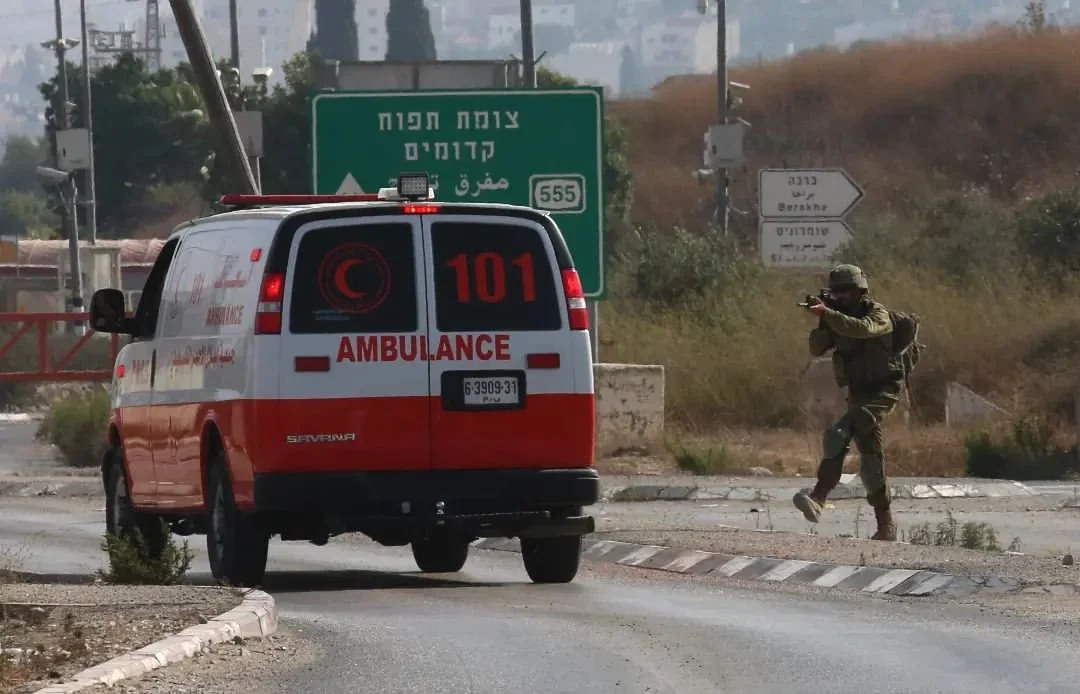
Israeli military vehicles, checkpoints, and roadblocks prevented ambulances from reaching wounded and critically ill Palestinians during an incursion into Jenin.
Ahmad Al-Samar’s father was forced to carry his critically ill son toward Khalil Suleiman Hospital because emergency vehicles could not reach them. Ahmad died before receiving treatment.
In a separate incident, Israeli soldiers delayed an ambulance carrying 36-year-old Fouad Abraha for approximately 30 minutes while demanding identification documents. Abraha bled to death inside the ambulance.
-
An Israeli airstrike hit a building beside the PRCS Ambulance Center in Jabalia, shattering the center’s windows and damaging the facility. Medical workers, wounded patients, families, and displaced civilians were sheltering inside.
-
Israeli tanks and bulldozers surrounded and entered the PRCS Ambulance Center in Jabalia, where approximately 127 people were sheltering. Those inside included paramedics, volunteers, their families, 22 wounded patients, and displaced civilians.
Bulldozers destroyed the entrance, fencing, ambulances, and communications equipment. Medical workers were stripped, interrogated, beaten, and detained. Women, children, patients, and other civilians were forced to evacuate under dangerous conditions.
PRCS workers detained during or following the raid included Muhammad Salah, Mohammed Abu Rukbeh, Saeed Al-Jarjir, Hudhaifa Abu Atiyya, Mohammed Abu Foul, Suleiman Abu Sharee’a, Hani Wadi, and Bahaa Abu Rukba.
-
An Israeli airstrike destroyed PRCS Ambulance No. 1206 on Salah al-Din Street near Deir al-Balah. The ambulance was transporting wounded patients when it was struck.
All four crew members were killed:
Yusuf Abu Ma’mar, ambulance driver
Fadi Fuad Al-Maani, paramedic
Islam Abu Riyala, first responder
Fuad Abu Khammash, PRCS volunteer photographer
-
Israeli military vehicles blocked several ambulances outside a hospital in Tulkarm. Soldiers entered and searched the ambulances while wounded and killed Palestinians waited to be transported.
PRCS ambulance officer Safia Belpisi and volunteer paramedic Abdullah Nairat were injured, and an ambulance was damaged.
-
PRCS dispatched Ambulance No. 1074 to rescue six-year-old Hind Rajab, who was trapped inside her family’s car in Tal al-Hawa. PRCS stated that the ambulance’s route and rescue mission had been coordinated with Israeli forces.
Contact with the crew was lost shortly after the ambulance entered the area. Twelve days later, the ambulance was found destroyed near Hind’s family car.
Paramedic Yousef Zeino and ambulance driver Ahmad Al-Madhoun were killed inside the ambulance. Hind and members of her family were also found dead.
-
PRCS footage documents extensive destruction at its Jabalia facility, including damage to four ambulances.
Affected: PRCS workers and emergency medical operations. No individual victim is identified in this particular evidence.
-
Israeli forces opened fire on a convoy of five ambulances evacuating patients from Al-Ahli Arab Hospital. The passengers included children with cancer, child amputees, and accompanying family members.
PRCS reported that the evacuation mission and route had been coordinated in advance. Paramedic Muhammad Al-Omari was killed, while ambulance captain Saleh Abu Amar and another paramedic were injured.
-
Israeli forces opened fire on PRCS Ambulance No. 1071 while it transported oxygen cylinders between Nasser Hospital and Al-Amal Hospital.
The ambulance’s front and rear windows were struck repeatedly. An unnamed PRCS ambulance worker sustained bruising and scratches.
-
Following the Israeli military’s withdrawal from the Al-Amal area, at least six PRCS ambulances were found crushed, burned, partially buried beneath rubble, or otherwise rendered unusable.
Roads around the ambulance area were destroyed, and a large crater was left in the ground. A specialized intensive-care ambulance used to transport critically ill patients was reported missing.
-
Israeli forces stopped a PRCS ambulance crew attempting to transport a wounded patient from Al-Far’a Camp near Tubas.
Paramedic Wasim Mohamad Draghma was beaten and detained while providing medical assistance. He was later released and taken to a hospital for treatment. The ambulance was also struck by gunfire.
-
A PRCS volunteer paramedic was shot in the foot while performing humanitarian duties during an Israeli military raid on Nur Shams refugee camp. Israeli forces then obstructed the ambulance attempting to transport the wounded paramedic to a hospital.
-
PRCS volunteer paramedic Mohamad Awad Allan Musa was killed while providing medical assistance to Palestinians injured during a settler attack in Al-Sawiya, south of Nablus.
-
Israeli forces destroyed a PRCS medical post inside Tulkarm refugee camp using explosives. The attack damaged a facility used by emergency medical workers to provide treatment during military incursions.
-
A PRCS facility in Khirbet al-Adas, eastern Rafah, was attacked and heavily damaged. Smoke was seen rising from the building, and an ambulance parked outside also appeared to have sustained damage.
-
PRCS volunteer paramedic Hamza Al-Jitawi was shot by Israeli forces while attempting to reach people wounded during a military raid on Nur Shams refugee camp in Tulkarm.
-
Israeli forces detained PRCS paramedics as they attempted to reach a wounded man inside a building in Jenin. The medical workers were forced to exit with their hands raised and retreat to their ambulance, leaving the injured man behind without treatment.
-
An Israeli strike directly hit a PRCS ambulance operating in Tal al-Sultan, western Rafah, killing paramedics Haitham Tubasi and Suhail Hassouna. The ambulance caught fire following the attack.
A second ambulance was sent to rescue the crew but also came under attack. Additional paramedics attempting to reach their colleagues were fired upon and forced to retreat.
-
Following the Israeli military’s withdrawal from Jabalia, multiple PRCS ambulances were found destroyed. At least one ambulance appeared to have been crushed by a military vehicle, while another was recovered and removed on a tow truck.
The exact dates the ambulances were destroyed have not been established. The destruction was documented between 1 and 3 June.
-
Israeli military vehicles blocked PRCS Ambulance No. 6-3458-31 during an incursion into eastern Nablus. In a related incident, PRCS paramedics were prevented from transporting a wounded patient, who was removed on a stretcher and placed inside an Israeli military vehicle.
-
PRCS workers returned to their medical point inside an UNRWA clinic in Jabalia and found the facility extensively damaged. Medical supplies and equipment had been destroyed, doors had been torn from their frames, and parts of the facility had been burned.
The destruction reduced the emergency medical services available to residents of Jabalia.
-
Israeli military vehicles blocked PRCS Ambulance No. 6-3723-31 during an incursion into Tulkarm, preventing the medical crew from moving through the area and reaching people requiring assistance.
-
PRCS paramedics attempted to reach a wounded person lying in a road in Jenin. Direct gunfire forced the crew to abandon the rescue attempt and retreat, leaving the injured person without immediate medical assistance.
-
Israeli soldiers stopped PRCS Ambulance No. 6-3457-31 in Nablus and approached the medical crew while carrying rifles. The ambulance was prevented from continuing until the soldiers completed their inspection.
-
A seriously wounded Palestinian man was left lying in the street during an Israeli military incursion into Jenin. Restrictions on ambulance movement prevented emergency medical workers from immediately reaching and treating him.
-
A PRCS ambulance came under gunfire while traveling through Tal al-Sultan in Rafah. The crew continued driving while shots were fired toward the emergency vehicle, placing the paramedics and their medical mission at risk.
-
Three Israeli soldiers blocked the passage of a PRCS ambulance in Bethlehem, preventing the medical crew from continuing through the area.
-
Israeli soldiers shot and injured a Palestinian man in the Jabriyat area of Jenin before fastening him to the hood of a military vehicle. The vehicle drove past two ambulances that could have provided him with emergency treatment.
The wounded man remained exposed on the vehicle’s heated metal surface while the military convoy moved through the area.
-
An Israeli airstrike hit Al-Daraj Medical Clinic in Gaza City, killing the director of Gaza’s ambulance and emergency services and another medical worker. The attack damaged a clinic serving women, children, and displaced civilians.
Killed:
Dr. Hani Al-Jaafarawi — director of Gaza’s ambulance and emergency services
A medical worker identified in the evidence only as a colleague from the Salah family
-
An Israeli airstrike hit Al-Daraj Medical Clinic in Gaza City, killing Dr. Hani Al-Jaafarawi, the director of Gaza’s ambulance and emergency services. Another medical worker from the Salah family was also killed.
The attack heavily damaged the clinic’s maternity and child-health services and removed one of Gaza’s senior emergency medical officials from an already devastated healthcare system.
-
An Israeli airstrike hit the Civil Defence headquarters in Nuseirat refugee camp, killing three Civil Defence workers and injuring another worker and several civilians, including children.
Killed:
Ziad Al-Habbash
Ammar Awad
Abdul Ghaffar Asaad
The attack damaged the headquarters, a rescue vehicle, and a fire truck used for emergency response. The loss of personnel and vehicles further reduced the ability of Civil Defence teams to rescue civilians, fight fires, and respond to attacks in central Gaza.




Legal relevance
Ambulances, medical personnel, medical units, and humanitarian medical operations are protected under international humanitarian law. Intentionally directing attacks against protected medical personnel, units, or transports may constitute a war crime.
Protection may only be lost under narrowly defined circumstances when medical assets are used to commit acts harmful to the enemy outside their humanitarian function. Even then, international humanitarian law generally requires a warning and reasonable time for compliance where circumstances permit.
The evidence in this package should therefore be assessed not as isolated incidents, but as a documented pattern involving direct attacks, obstruction, destruction of emergency capacity, detention of medical personnel, and interference with coordinated rescue missions.
Methodology and evidence preservation
Sarkha Project researchers reviewed original open-source material from PRCS, medical personnel, journalists, humanitarian organizations, news agencies, and other sources. Evidence was organized chronologically and by incident type, with translations, source information, descriptions, victim information, and preserved copies where available.
Multiple sources documenting the same incident were retained to support corroboration and preserve different perspectives. The complete evidence package and underlying archive are not published publicly in order to protect sensitive material, preserve source context, and maintain evidentiary integrity.
Conclusion
The evidence does not describe a handful of isolated ambulance attacks. It documents an emergency medical system repeatedly placed under assault.
Paramedics were attacked while collecting the dead, treating the wounded, evacuating patients, and responding to coordinated rescue missions. Ambulances were bombed, fired upon, obstructed, crushed, burned, and prevented from moving. Emergency centers were besieged, communications disabled, and medical workers detained.
The cumulative effect was not limited to the workers and vehicles directly attacked. Every time an ambulance was prevented from arriving, a paramedic killed, or a dispatch system disabled it reduced the possibility of survival for the civilians who depended on them.